Fantastic Arcade! Mondo Blog
September 25th, 2010
FANTASTIC ARCADE
In a world where art is continually borked by commerce, no form is bullied harder than the videogame—the much-maligned stepchild of MOVIES, TABLETOP GAMES, LITERATURE, SPORT, and NIGHTMARE. At their best, games demand you actually interact with them, instead of just staring while cramming chee-toes into your face. But since humanity’s problem-solving ability (and capacity for complete sentences) seems to be waning, any game that asks players to think or feel beyond the sugar-high of shooting strangers in the head—then grunting slurs about their sexuality—is quickly labeled profit-killing poison.
That’s why an independent game festival matters. And to have one under the canopy of Fantastic Fest feels like a gift. Strange, imaginative games are being hatched out on the margins. They may not appeal to corn-syrup–fattened rugrats or dead-eyed, gun-nuzzling fratboys who wear the demographic badge of “gamer,” but sameness and withered imagination shouldn’t dictate what the rest of us get to experience. Especially when so much more is possible.
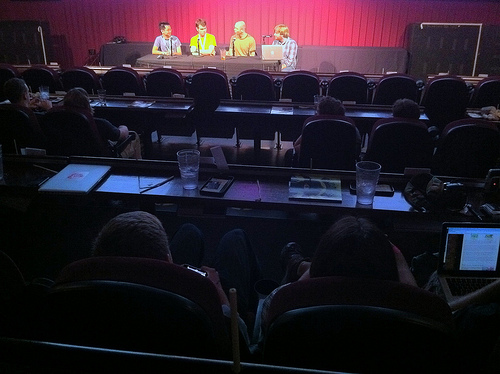
IGF chairperson Brandon Boyer conducts a panel with “Spelunky” creator Derek Yu, “Braid” creator Jonathan Blow, and “Everybody Dies” creator Jim Munroe.
Fantastic Arcade, co-curated by Mike Plante (who previously nurtured CineVegas), debuts this year with panel discussions featuring some of the most interesting personalities in the scene. Indie games from around the world have been built into full-size arcade cabinets, while rows of PCs showcase more titles—plus a lovingly recreated Alamo South Lamar and Highball rendered as a Left 4 Dead 2 mod. Console stations line the walls, and the Highball’s karaoke rooms host featured play areas.
I’ll be highlighting a few games each day of the festival, with photos and clips as I stumble through.
Sword & Sworcery EP
“rustic 21st-century minimalism”
Not yet released but already buzzing, Sword & Sworcery is a stark, fat-pixeled adventure recalling moody, cinematic classics like Out of This World. The developers are here at Fantastic Arcade to show it off, so here’s a quick preview. It’s an iPhone/iPad game that uses the touchscreen for controls and orientation to toggle between exploration and battle. I’ll post a longer S&S:EP piece after Craig Adams’ talk.
Many new indies are skipping prefab 3D engines, returning instead to 2D graphics and pixel art. Whether for rapid prototyping, or simply because fundamental gameplay feels worth mastering again instead of hiding, sometimes simple really is best.
Norrland
If nihilistic Swedes had made a hunting game for the Atari 2600 in the ’80s, it would look like Norrland. Menacing and hilarious, the game involves humping dead deer until a geyser erupts from their neck stumps, drinking beer, shitting in the woods via button-mashing, and drifting through bizarre dream-sequence minigames—like Swordquest redesigned by ether-bingers in the Carpathians.
Often I had no idea what I was supposed to do in a given minigame, but frustration and drudgery are part of the theater here. One highlight: when an animal charges and you’re out of bullets, you can punch it in the face. Swedish title cards with English subtitles make this the most cinematic 2600-style game ever. Fuck you, E.T..

Every Day the Same Dream
Every Day the Same Dream uses video game conventions to satirize real life: an endlessly repeating workday, mapped through every possible deviation (like going to the office without clothes). The limitations of linear games translate neatly into a parody of the actual work grind.
Here, repetition means attrition and failure; any deviation—even suicide—counts as success.
Built in just six days for a game jam, EDTSD shows how contests often yield quick, pure experiments. (Cannabalt by Adam Atomic is another great example.) It’s stripped down, sharp, and direct.